So you may or may not have noticed that I’m not posting that much here anymore. Yet I’m still active on Instagram. Even thought Instagram had fucked up with artists when feed started being about post popularity, Tumblr is way worse now.
Many, many of my drawings got censored and TAKED OUT OF SEARCH for being “”“”+18, like my very adult drawing of Nico and will kissing???????¿ So you guys now I have a blog for adult drawings, and if my regular ones are being taked out of search for no reason I have no way of surviving here. As if Tumblr was not dead enough yet, they now are forbidden all adult posts, what means that I’m gonna lose one of my blogs and also my drawings that are not adult but somehow got flagged as are going to be deleted as well.
So please, if you wanna see more of my work, follow me on Instagram! @brunegonda or @their.name.is.brune for cosplays! And please, share it so others can also see it.
I wish things could stay cool here cause I really like Tumblr as it was, but there is no way out I think. I’m sorry for my English, and I wait for you guys there ❤
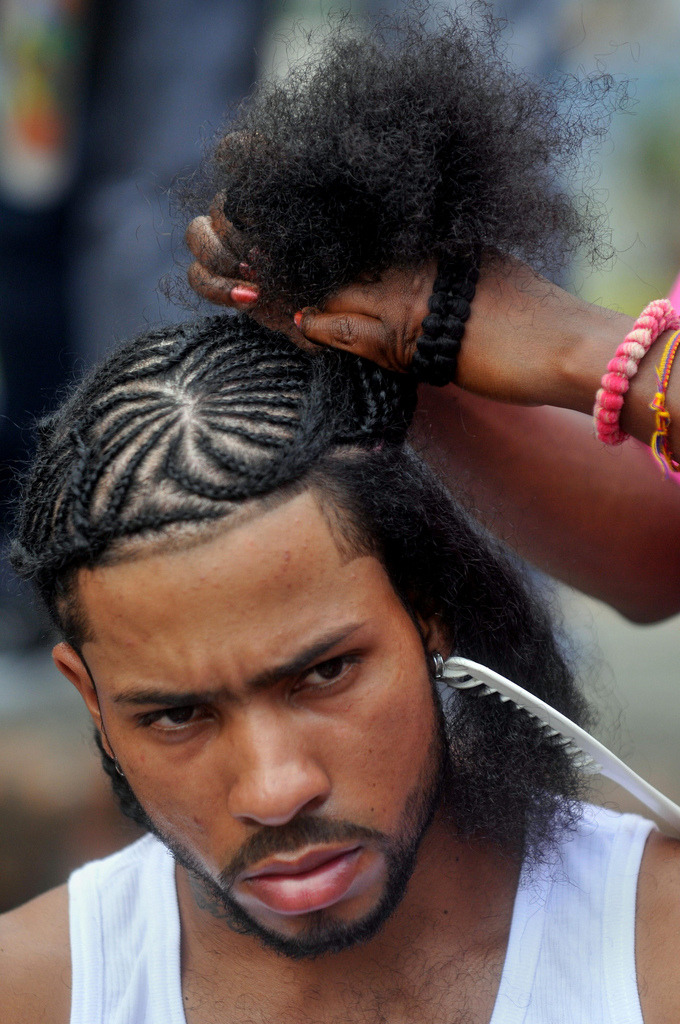
A man participates in a hair exhibition during the 8th annual Afro hairstyle contest in Cali, Colombia. An event that is held during the month of may which aims to highlight the traditions, culture and history of Afro Colombians.
Part 1 of 3. Part 1 is Female Fashion in
Mesoamerica.
Unfortunately
since some have been stealing and even selling my work I have to watermark my
images now and post in low resolution. But I will soon have these on patreon to
view full size or to buy as poster prints.
On
to the set. I have broken it down into basic garment type. A couple things I
should mention are that the examples here are used only as an example of the
garment being displayed. It does not mean that the specific culture showing it
here was the only one to wear it. Many of these garments have regional,
ethnic and temporal varieties, however some are indeed specific to certain
cultures which I will mention. I tried to show a variety of cultures and time
periods simply to highlight different uses of the garments. Notable civilizations
like the Mexica or Olmec for example are not shown here but that doesn’t mean
they didn’t have skirts for example.
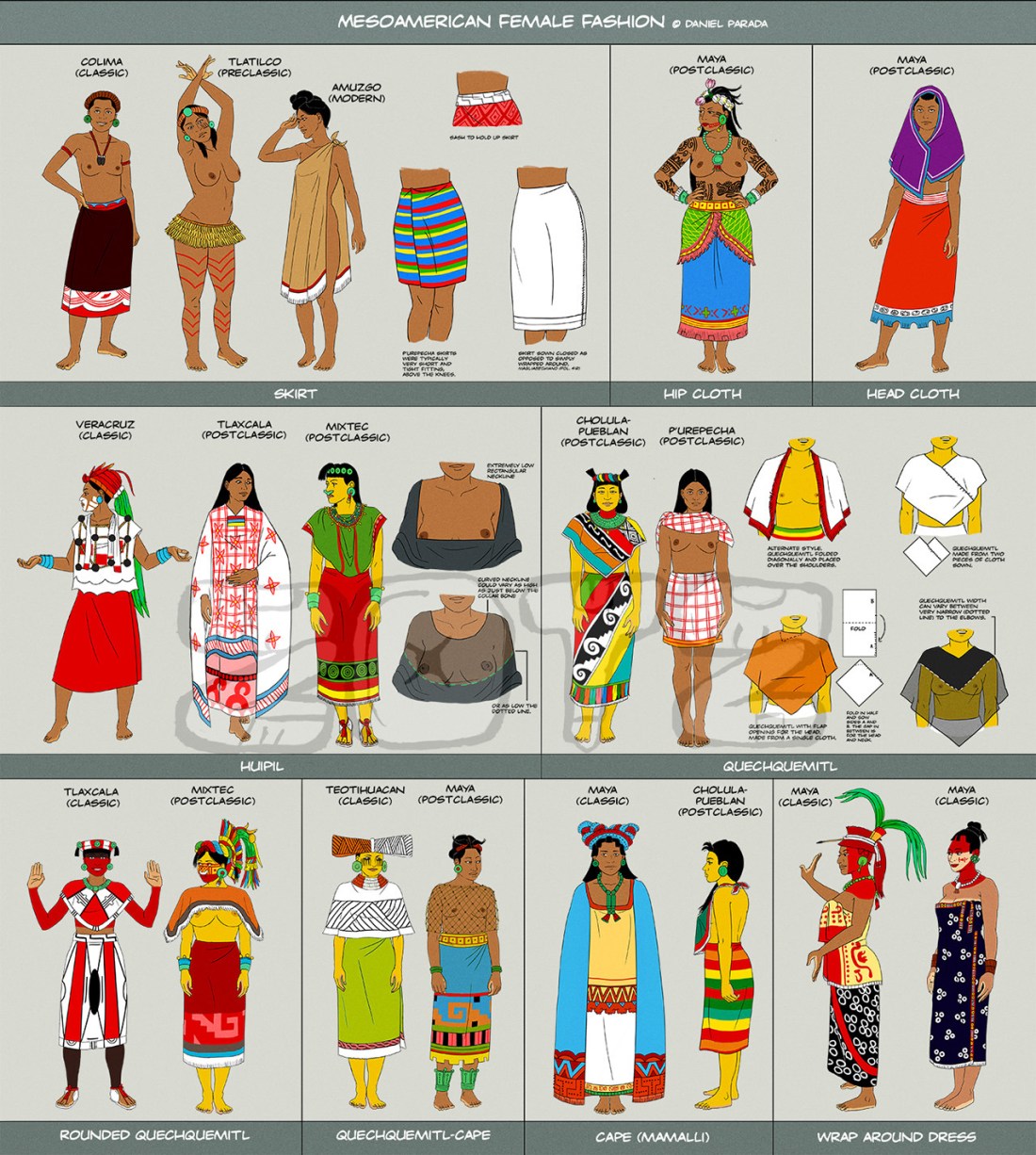
Skirt
The first is the basic skirt. Based
on a Classic period figurine of Colima (part of the West Mexican people’s of
Mesoamerica). She wears a wrap around skirt held by a belt or sash at the hip.
The skirt was among the most basic garments for women, and worn virtually by
all people’s. It is worn here as the only garment as was the case in many
places and time periods. But in colder climates or certain contexts it was
usually worn with another garment. Skirts were made of a single rectangle of
cloth. They were made with cotton, maguey or vegetal fibers and worn plain, or
with designs and colors and sometimes embroidered with stones or feathers. The
Chichimeca made their skirts with animal skins.
Next is a Preclassic Tlatilco
woman wearing a type of skirt with grass or reed possibly. These were very
short, just barely covering the groin or part of it. These are unique to the
Preclassic period though not unique to Tlatilco culture in Central Mexico as it
appears in El Salvador’s late Preclassic Bolinas tradition. Nevertheless it
does not appear to be that common even in the Preclassic.
This next one is a hypothetical
Precolumbian style based on more modern ways of wearing the skirt. This way of
wearing the skirt is unique to the Amuzgo women. It was worn similar to a male
cape only with nothing else worn. Nowadays it is worn with straps resembling a spaghetti
strap dress. While no Amuzgo art shows this unique way of wearing the skirt in
Precolumbian times, it is included as a possibility if it was worn in such a
way.
The next examples show different ways
of wearing the skirt. The first example shows a wrap around Mexica skirt held
together with a white sash. Other ways of holding up the skirt included making
a tie or fold in a similar way one wraps a towel around the body today. A
Mexica example also shows something like a rope belt. The next example shows a
short skirt above the knees worn by the P’urepecha. Skirts of this length are
exceedingly rare outside of the P’urepecha and perhaps some Preclassic types.
The next example shows a skirt sown together rather than wrapped around.
Hip Cloth
The hip cloth seen here is worn
by a Maya woman in the Postclassic period seen in the Dresden codex. This
garment was worn over the skirt and held by a belt. Sometimes they were folded
rectangular clothes into a triangle shape and then wrapped over the body. Some
versions show two, one in front and back creating an apron like look over the
skirt. It was probably made of cotton or maguey fibers.
Head Cloth
The head cloth was a rectangular
fabric worn over the head and wrapped over the body. This example is a
Postclassic Maya type, based on descriptions at the time from Europeans. It was
usually worn when not at home, such as going into the market or traveling in
place of an upper body garment. Some Classic period Maya women are seen wearing
this over their hair or headdress and it is seen still worn by Mixtec women in
Oaxaca’s Jamiltepec District, particularly in Pinotepa Nacional. It was
probably made of cotton or maguey fibers.
Huipil
The origins of the Huipil are
still unknown but some speculate it came from the South, perhaps South America.
It is a sleeveless blouse, and worn by many people throughout Mesoamerica as an
upper body garment. This first example shows a short-medium length huipil worn
by a woman from Veracruz in the Classic period as seen in a mural. The unique
cut on the hem however seems unique to them. Like the skirt this could be made
of cotton, maguey or vegetal fiber or animals skins for the Chichimeca. And it
can be plain, or with decorations and embroideries like feathers, stones or cords
like this example has.
This example is a large huipil,
covering most of the upper body, reaching the wrists and extending to the
knees. This is worn by a Tlaxcaltec woman of the Postclassic period. Similar long
huipils appear in Classic Maya art and among the Mexica and other Nahua peoples.
This particular examples has a little patch that is sown at the opening,
presumably to help hold the small opening in place and to prevent tearing.
Next is a huipil worn without
placing the arms through the armholes, just letting the garment sit over the
shoulders. This variety was also said to be worn by the Postclassic Maya
similar to the headcloth. Curiously, it also appears among the Mixtec, which
this example comes from based on the Codex Zouche Nuttall. Scholars debate
whether some depictions labeled quechquemitl (a garment I will talk about
later) are actually huipils worn in this manner. It is still worn in this way
in parts of Jamiltepec.
Lastly, we see different collar
openings for huipils. The Tlaxcaltec and Nahua varieties seem to favor a slit,
however other types could be square or curved openings. In most places the
huipil neckline was just under the clavicle. However, the Maya
had a range of neckline lengths in the Classic period. Some were so low it
slung slightly under the breasts. These very low necklines seem to have been
favored by elite women as a fashion trend.
Quechquemitl
The quechquemitl was another
garment from the North, carried by the Chichimeca to Mesoamerica. It was worn
particularly in Veracruz and West Mexico, with varieties worn in places like
Teotihuacan during the Classic period. By the Late Postclassic it was seen in
the Maya region and even as far as Nicaragua. It is a garment that garment with
an opening in the center for the head, with two sides covered and two other
sides exposed. They can be made of one or two pieces of fabric. Typically the
covered parts where the chest and back while the arms and sides were exposed.
This example is worn by the Cholulan-Puebla area based on the Codex Borgia of
the Postclassic period. These were made with a variety of materials and
decorated like the aforementioned garments.
This is a quechquemitl worn sideways
by a P’urepecha woman. One of the points on the side is folded over to one side
creating a scarf-like look, also due to the quechquemitl being very short. This
style of folding over to one side seems unique to the P’urepecha.
The following are types of
quechquemitls and how they are worn. The first example is from Papantla,
Veracruz, worn by the Nahuas in modern day, it’s a hypothetical reconstruction
of how it would look in precolumbian times if it was worn in this manner. The
second example shows a quechquemitl constructed from two pieces of cloth. it’s
sowed at a perpendicular angle and the two sides are folded back to meet on the
opposite ends where they are sewn. The third example below is made from a
single rectangular piece that is folded in half and the two extreme ends are
sown. This method however created a little flap in the middle where the head
passes, which can be tucked in or folded out. The last example we see varying
lengths a quechquemitl can take
Rounded Quechquemitl
This is an type of quechquemitl
which has rounded corners rather than
straight ones. This example comes from Tlaxcala in the Classic period. This
style gives off the impression of a more circular/curved look.
The second round quechquemitl
shows the same garment but worn sideways, with the points on the shoulders and
arms, leaving the torso and back exposed. Similar to the P’urepecha way except
it is not folded to one side only, simply shifted to the side. This style comes
from the Mixtec codex Zouche Nuttall. It is also a style seen among the Mazatec
of Oaxaca.
Quechquemitl-Cape
This is a type of quechquemitl
that is a bit of a fusion with a cape. It can be confused with a rounded
quechquemitl however due to the rounded appearance it gives if one raises their
arms. It is two rectangular pieces with a hole in the middle for the head, and
a large opening for the arms and torso on the bottom. In a way it can also be
thought of as a huipil without sleeve holes. This style appears among the
Classic Maya and was the prime garment of choice for women in Teotihuacan as
this example shows. Clavijero mentions Aztecs wearing such a garment over their
quechquemitl’s.
A variation of this garment was
worn by the Maya in the town of Chunchuchu during the Postclassic period. This
style was netted, presumably tied like a net. While it is unusual in that this
was made just with cords, it is not unprecedented, netted capes for instance
are seen among certain Mexica men.
Cape
While capes are typically seen
among male fashion, there did exist a female cape as well. This one is worn by
a Maya woman of the Classic period over her huipil and skirt. This example
appears to not be tied up and just ‘placed over her’. However in Mixtec and Cholulan-Pueblo
codices short capes are sometimes worn over quechquemitl’s or as a single upper
body garment. However these Postclassic capes are all short, unlike the Maya
one here which covers most of the body.
This short cape comes from the
codex Laud, of Cholulan-Pueblo origin. It is a ‘front cape’, that is the cape
covered the torso in front but left the back exposed where it was tied at the
neck. Due to its short size and being worn in front it gives an ‘apron’ like
appearance.
Wrap-Around Dress
The wrap-around dress was a
single piece of cloth wrapped around the body, under the arms, and tied or
secured at the front or near the armpit. This is the shorter style, where it’s
used more as an upper body garment accompanied by a skirt. This style is unique
to the Classic and Postclassic Maya.
This version of the wrap-around
dress functions as a single garment to cover the whole body wrapped under the
arms. Due to its length covering most of the body, a skirt wasn’t necessary to
wear with this underneath. This style is unique to the Classic Maya, and while
it may have been worn in the Postclassic by them as they had the shorter
variety, it is not seen in any depictions or mentioned in sources.
To conclude this part I’ll
mention that there are a few garments I will instead add to part 3, that would
have gone here, this includes ritual attire and unique kinds of weaving.
Sources:
-Acala, Jerónimo de. 1540. Relación
de Michoacán.
-Aguilar-Moreno,
Manuel. 2005. Handbook To Life In The Aztec World.
-Amaroli, Paul. 2017. Arqueología
de El Salvador.
-Anawalt, Patricia Rieff. 1986.
Indian Clothing Before Cortes.
-Anawalt,
Patricia Rieff. 2005. “Atuendos del México antiguo”, Arqueología Mexicana, edición especial, núm.
19, Raíces, México, pp. 10-19.
-Benzoni,
Girolamo. 2017. History of the New World, trans. Jana Byars.
-Clavijero, Francisco, Javier.
Historia antigua de Mexico, 4 vol.
-Codex Borgia
-Codex Dresden
-Codex Kingsborough
-Codex
Laud
-Codex
Mendoza
-Codex
Zouche Nuttall
-Cordry
and Cordry. 1968. Mexican Indian Costumes.
-Herrera, A. 1726-30. Historia
General de los hechos de los Castillanos en las islas i tierra firme del mar océano
(5 vol)
-http://research.mayavase.com/kerrmaya.html
-Jose
Maria Asensio. 1898-1900. Relaciones de Yucatan (2 vol)
-Landa, Diego de. 1566. Relación
de las cosas de Yucatán.
-Lienzo
de Tlaxcala
-Mural of las Higueras
-Mural of Santa Rita Corozal
-Ponce, Fray Alonso. 1873. Relación
breve y verdadera de algunas cosas de las muchas que sucedieron al padre fray
Alonso Ponce en las provincias de la Nueva España siendo comisario general de aquellas partes, escrita por dos religiosos
sus compañeros, 2 vol. Madrid.
-Sahagún,
Bernardo de. 1590. Florentine Codex, trans. Charles E. Dibble and Arthur J.O.
Anderson, in 3 parts, vol 1-13.
-Smith,
Michael E. 2003. The Aztecs 2nd edition.
-Soustelle,
Jacques. 1961. Daily Life of the Aztecs on the Eve of the Spanish Conquest.
-Stone,
Andrea J. March, 2011. “Keeping abreast of the Maya – A study of the
female body in Maya art”, Ancient Mesoamerica Vol. 22, Issue 01, pp. 167 –
183.
-Stresser-Pean,
Claude. 2011. Des vêtements et des hommes. Une perspective historique du
vêtement indigène au Mexique. Le vêtement precortésien.
-Townsend, Richard and Anawalt, Patricia Rieff (Editor). 1998.
Ancient West Mexico: Art and Archaeology of the Unknown Past
Trigger Warning: Maybe sensitive for some people to watch.
Ughhhhh!! I had a similar experience 2 or 3 years ago. I was bald at the time and 2 Jamaican men saw me walking through the Bronx. I had to run.
This happened to my sister’s friend but she was actually assaulted going into a women’s restroom.
What is wrong with men!!!!!
This type of shit is exactly why you can’t focus on one issue without confronting the things that it intersects with, because they all go hand in hand.
This is transphobia/misogyny, homophobia, misogynoir and hyper-masculinity all at one time, omg
I think this is why you cannot remove race from issues of gender and gender rep. I have had white cis gay dudes grab my breasts hard, like yanking on them to see if I was trans as if chest tissue isn’t attached to your body period. I think this a very unique experience for black women, trans and cis, because our femininity is called into question no matter what. I mean misgendering black women is a very common thing.
this has happened to me, it is never fun. i always get nervous when pl in stores/eateries call me sir because ppl take it as an invitation to confirm their suspicions or get violent. but i’m also like 5 feet of repressed anger issues so god help whoever steps to me in these streets
NO WOMAN DESERVES THIS!!! Regardless of whether she’s cis or trans….. this is unacceptable and traumatizing 😕💯
Follow the original link for subtitles and full video!
When I was 10, my mom made me wear a bra and it felt like a punishment for being different.
When I was 10, I took the bra off when changing for gymnastics and accidentally dropped it in the school hallway. A teacher picked it up and said, “Oh, this must belong to you” and handed it back to me in front of everyone. I quit gymnastics.
When I was 11, I thought maybe the boobs would be okay so long as they didn’t get any bigger than would fit in my hand, so I kept measuring it, but they did.
When I was 12, I started wearing two or three sports bras to smush them down, until one day a classmate said, “Are you wearing two bras?!” while laughing.
When I was 13, a boy told me he wanted to squeeze my boobs “until they popped.”
When I was 14, I got cast in a play as an older character and a classmate told me I got the role because I had boobs.
When I was 17, my mom told me to return a swimsuit because it would be too distracting for my boyfriend’s father.
When I was 21, I got properly fitted for a bra and everyone felt the need to tell me how much better my boobs looked.
When I was 26, I got pregnant and my immediate fear was that my boobs would get bigger.
When I was 28, I got shamed for trying to feed my screaming baby in public without a cover.
When I was 28, people asked me “why are you bothering to use a breastfeeding cover?”
When I was 30, people gave me weird looks that I wasn’t yelling at my kid for putting their hand on my boob.
When I was 31, I avoided going to the beach or pool because I didn’t want to have to deal with boobs in a swimsuit.
When I was 32, I got asked, again, “why don’t you get a breast reduction?”
When I was 33, I watched a 5yo girl get shamed for running around in sweltering heat without a shirt on and had to reprimand a bunch of tween boys who thought it was okay to shame her for doing something they do all the time.
When I was 34, my kid kept patting my breast and saying “Mommy’s squishy breast!!” They will never see me express any shame about tits, because I want them to have a different mindset than I had. Yes, boobs are nice! They’re squishy! They’re fun! That’s the end of that.
I’m 35 and no longer give a fuck. I don’t care anymore. As a teenager my tits were covered in stretch marks. They’ve been engorged with milk. My nipple changed shape with pregnancy. Give it another couple decades and my breasts will probably be all wrinkly. It’s sexual when I’m using it sexually. I don’t fucking care, and I won’t be ashamed anymore.
Every time a policy or cultural hangup treats people with breasts differently, it fucks us over.
Tumblr’s new policy makes an active choice to participate in this culture of shame. By classifying “female-presenting nipples” as explicit material, Tumblr has taken a stance that any chest or breast that differs from a male default is worthy of shame and unavoidably sexual. The idea that breasts are shameful and unavoidably sexual is exactly what fucked me up for so much of my life.
Stop shaming people for having bodies.
I’ve been seething in rage thinking of this all day and @aibidil put into words what was reeling in my mind.
2009 – GeoCities shuts down, taking old fannish websites
2010 – FFN forums deleted
2011 – Delicious destroyed by Yahoo’s incompetence
2012 – major FFN crackdown on porn
2014 – Quizilla shuts down
2015 – Journalfen’s servers become fully robust, deleting Fandom Wank
Didn’t quizilla have purges before finally shutting down? And I know basically every vidding home hot destroyed, repeatedly taking out the entire history of vidding online.
… they deleted Fandom Wank???
Well, not specifically. Journalfen failed completely and has never come back. FW was on Journalfen, so while you can see some entries on the Wayback machine, I think (?), the long comment threads aren’t archived.
2007 – Youtube starts using its “content ID” system to identify (and block) works that include copyrighted material in their database.
2009 – Greatestjournal shuts down, taking down fandom’s biggest collection of blog-style RPGs
2012 – Megaupload shut down by FBI; some (many?) fanvid archives lost
I thought there was also some kind of purge at Deviantart, but I don’t recall the details.
I’d like to remind folks that there was literally wank last month about why do we need the OTW.
Well, this would be why: we sincerely believed in the internet values of a decade or two ago, which involved owning our own servers if we wanted to see our projects remain stable, in the long term, online.
Worth mentioning: Yahoo purchased GeoCities, and was behind the decision to shut all those sites down.
Yahoo’s incompetence destroyed Delicious.
Yahoo owns Tumblr.
1356: 50% of monks.
People just… completely forget. I was there for all of the bans on fanfiction.net. You don’t know panic until you go to log in one morning and find out a bunch of your works have been deleted, gone forever, because some asshole arbitrarily decided that they wanted to ban something.
AO3 IS IMPORTANT. IT MATTERS.
2016 -y!gallery an archive of m/m art and stories, original and fanfiction was completely destroyed and all works were lost
Y!gallery itself was originally built in response to Sheezy art banning adult themes in 2005
Deviant Art in my experience says it doesn’t allow porn but will allow erotic art of women to reach the front page, straight male gaze gets a pass. Art focused on men is more likely to get deleted.
A lot of things destroyed by anti-porn rules are really anti-porn not made by and for straight men. It’s women’s and queer folks work that is demonized.
^^^^^ i actually tested this when i was on DA. I drew a bunch of s*xually e*plicit vag*nas and d*cks and the d*cks were removed within 24 hours. the vag*nas were never reported.
these bans are attacks on women and queer/LGBTQ people. the straight male gaze is apparently the only legitimate n sfw view
2010 ish (?) – deviantART purges adult fanfiction (I only very vaguely remember this one, because I’ve never been a dA user and it happened during my fannish hiatus, but there is some incomplete info on Fanlore. If you remember more about what happened, please help edit that page!)
Fandom purges are almost never just about one thing. Fannish content both relies on fair use exemption and is frequently sexually explicit, so it gets attacked on both copyright/legal grounds (thank you, OTW Legal Team, for protecting us!) and TOS/hoster rules about porn/specific fictional content (thank you, AO3, for being an open archive!). On top of that, there is a nontrivial history of fannish content being lumped in with content that criticizes authoritarian governments, and targeted by sweeps by those governments and their censorship agencies when they purchase or put pressure on the commercial entities that own the servers (thank you, OTW, for being a nonprofit and owning and defending our servers!).
If you care about fannish content, you have to fight for fanfic on all three fronts. And if we hop off of HTTP and onto one of the decentralized protocols like dat et cetera, like people are starting to talk about in response to Article 13 and the Tumblr purges, we will inevitably be targeted along with a) people pirating media, b) porn distributors, and c) anti-government protestors, because those groups are also going use those protocols, too. I’m not saying, don’t think about migrating. I’m saying: there is a systemic problem within fandom, regarding the fact that we routinely get hit on three fronts: legal rights to the material we transform, sexual content, and governmental disapproval. Protecting fandom means fighting for fandom on all three fronts and putting thought and effort into how to make an archive robust against all three prongs of the attack.
This is what’s made AO3/the OTW so special: we have lawyers protecting our right to make what we make, we have a TOS that protects our right to make things that are sexually explicit, and because the OTW is a nonprofit, it’s more robust to the pressure that can be brought to bear upon commercial entities by both corporate and governmental powers (though, I note, especially when it comes to governments, it’s not immune, and we have to keep actively protecting it, and we have to protect other fans). If you are in fandom but you think that copyright upload filters are fine, because, well, you don’t want to put fanvids on YouTube, you are part of the problem. Your community is under attack. The powers that be have always come for us by attacking us in pieces, and we have always only ever successfully fought back by banding together.
I was there for all of these. After FFN banned a lot of stuff I felt homeless until I found Tumblr.
I stress again that you can’t and should not rely on private corporations to keep your content (or anyone else’s) safe.
Especially in the current scenario of conservative politicians acting against liberal ideas, those companies have your data. They know who you are. For the right money/lobby they’ll do anything.
That’s why OTW is a safe heaven and I owe them my peace of mind. I really hope one of the similar initiatives I’ve been hearing that could replace Tumblr come to fruition. We need it.
Cristóbal Céspedes Lorenzo sits on his raft while carrying coconuts across the river to his home in Copala, a mainly Afro-Mexican community in Guerrero.
Cristóbal and Francisco Manzanares Cagua both work picking coconuts which they then sell to a local company which makes coconut butter and oil.
This image comes from the “Solar Portraits” project which addresses the important issue of lack of electricity around the world. It is a series of portraits depicting the lives of inhabitants of remote areas worldwide who, for the first time, have access to electricity through the power of solar energy.


 Ignisfilimundi