Located just outside of Herculaneum, the enormous seaside Villa dei Papiri may have been owned by the father-in-law of Julius Caesar, Lucius Calpurnius Piso Caesoninus. Built around 30-20 BC, the villa had four levels terraced into the hillside and an extremely long peristyle garden. It is named after the library of 1800 Greek and Latin papyrus scrolls, containing texts related to Epicurean philosophy, found on the site. Along with Herculaneum, the villa was buried under 30 meters of ash and rock in A.D. 79, and, over the centuries, its existence was forgotten.
The site was accidentally rediscovered in 1750. The goal of the first exploration of the site, authorized by the Bourbon King of Naples and directed by archaeologist Karl Weber, was not excavation, but the recovery of antiquities. To achieve this end, tunnels were cut through the compressed volcanic matter into the rooms of the villa, which were then cleared of rubble.
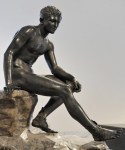
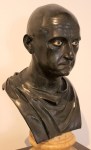
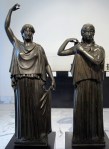
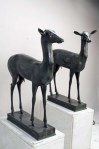
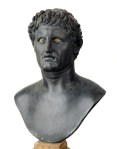
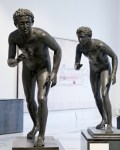
These subterranean labors paid off handsomely. The largest statuary collection from antiquity to have survived intact, comprising over 80 bronze and marble statuary of the highest quality, was discovered, scattered around the large peristyle and tablinum. The masterpieces, now in the Museo Archeologico Nazionale in Naples, included a copy of the Doryphorus of Polykleitos, a bust of Scipio Africanus, and a Seated Mercury. Once these works, along with deposed frescoes and the papyrus library, were removed, the site was sealed and within a few decades its exact location once again forgotten.
Weber’s reconstruction of the villa was published in Le Antichità de Ercolano esposte(1752-92), a deluxe eight-volume catalogue of the antiquities unearthed in the region. Those conjectural drawings served as the master plan for oil magnate J. Paul Getty’s full-scale replica of the Villa dei Papiri in Malibu. Built in 1972-74 as a museum to house Getty’s collection of antiquities, the Getty Villa was intially dismissed by critics as a kitsch exercise in Hollywood historicism.
Following a lengthy renovation, the Getty Villa currently serves as the home of the J. Paul Getty Museum’s ancient art collection and as a center for the study of classical antiquity. With it oceanside setting, temperate climate, and impressive works of ancient art, the opulently-restored museum today is frequently praised by architectural historians for its convincing and compelling recreation of a luxurious Roman villa maritima.
In 1986 the location of the Villa dei Papiri was rediscovered and in the early 1990s, a portion of the building was scientifically excavated. Other than a limited incursion in 2007, no further work has been done, leaving over 2800 sq ft untouched.
The excavated portion of the Villa dei Papiri, seen above, is situated 30m below the modern city of Ercolano. The Packard Humanities Institute, which supports research in fields of study related to classical antiquity, has indicated a willingness to fund the excavation of the rest of the villa. Because further work on the site would require the relocation of the current residents, the demolition of buildings and the re-routing of roads in a region infamous for its ability to circumvent official policies, not to mention the expense involved in maintaining yet another monument, the Italian government has no immediate plans to accept that offer.



 Ignisfilimundi